Beneath the present church of Hexham Abbey lies a stone chamber that has remained largely unchanged for more than 1,350 years. The 7th-century crypt is the only surviving part of the original church built by Bishop Wilfrid in AD 674, and its walls incorporate Roman masonry that speaks to the deep layers of history beneath the town.
Wilfrid's Foundation and the Crypt's Survival
Wilfrid, Bishop of York, established a Benedictine monastery at Hexham in AD 674. The crypt he constructed beneath the church is the sole element of that original building to survive intact through centuries of Viking raids, Scottish incursions, and later rebuilding. While the present abbey church largely dates from the period circa 1170 to 1250 in the Early English style, the crypt continues to offer a direct physical link to the earliest decades of English Christianity.
The Structure of the Crypt
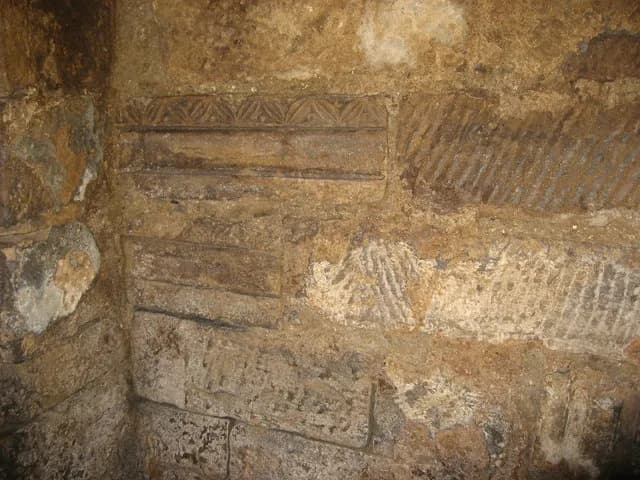
The crypt is a plain structure of four chambers. It consists of a chapel with an ante-chapel at the west end, two side passages with enlarged vestibules, and three stairways. The chapel and ante-chapel are barrel-vaulted. All the stones used in its construction are of Roman workmanship, and many are carved or bear inscriptions.
Roman Inscriptions in the Walls
One notable slab carries a partially erased inscription that reads: "IMP CAES L SEP PERTINAX ET IMPC AVR ANTONINV ... HORTE VEXILLATION ... FECERVNT SVB ...". This translates to a dedication to the Emperor Lucius Septimius Severus Pius Pertinax and his sons, the Emperor Marcus Aurelius Antoninus Pius Augustus and Publius Geta Caesar. The name of Geta was erased following his murder by Caracalla in a process known as damnatio memoriae, though it can still be discerned upon close inspection. The stone records that cohorts and detachments carried out the work under the command of an officer whose name is now lost.
The Tombstone of Flavinus
Elsewhere in the abbey stands the tombstone of Flavinus, a Roman standard-bearer and cavalry officer who died aged 25 in the 1st century AD. The slab is thought to have originated near the Roman fort of Coria at Corbridge and was brought to Hexham as a building stone in the 12th century. It was rediscovered in 1881 and now stands in front of a blocked doorway at the foot of the Night Stair. Although it is not located within the crypt itself, the stone is part of the same story of Roman material being reused within the abbey complex.
Visiting the Crypt Today
The crypt is open to visitors, though it is not accessible to everyone because of steep and deep steps. Those who are able to descend into the chamber can see a space that has remained largely unchanged since Wilfrid's time, its Roman stones still bearing the marks of their earlier histories.